
Discover the fascinating evolution of Palaeognathae, the oldest living bird lineage, and learn how ostriches, rheas, emus, cassowaries, kiwis and tinamous survived Earth's greatest mass extinction.
How this investigation began
A few weeks ago, my girlfriend and I were waiting at a car wash near my house. I had brought my laptop with me to work on some quotations for one of our GeoNature tours while she was talking to her father on the phone.
When their conversation ended, I asked her if I could say hello and thank him for inviting us to watch a few FIFA World Cup matches together. Unfortunately, that trip never happened because my visa application to the United States was denied.
During our conversation, however, he told me that he had another idea for a family trip. He wanted us to travel to Patagonia.
As we talked about the destination, he mentioned that Patagonia is home to a large bird called the rhea, which looks very similar to the ostrich.
That simple comment immediately caught my attention.
How could South America have a bird so similar to the African ostrich? Was it just a coincidence, or did they share a common evolutionary history?
As a geologist, my mind immediately connected the question with plate tectonics. My first hypothesis was that both birds descended from a common ancestor that lived on the ancient supercontinent Gondwana. When Gondwana broke apart, I imagined that populations became isolated on different continents and slowly evolved into the birds we see today.
It sounded like a beautiful explanation.
But as I kept reading scientific papers, I realized the story was much more fascinating than I had imagined.
Diving into the scientific literature
To answer my questions, I started reading scientific reviews and phylogenomic studies about these birds. At first, I thought I was only learning about rheas and ostriches, but I quickly discovered an entire evolutionary lineage that I had never heard about before.
My understanding changed completely.
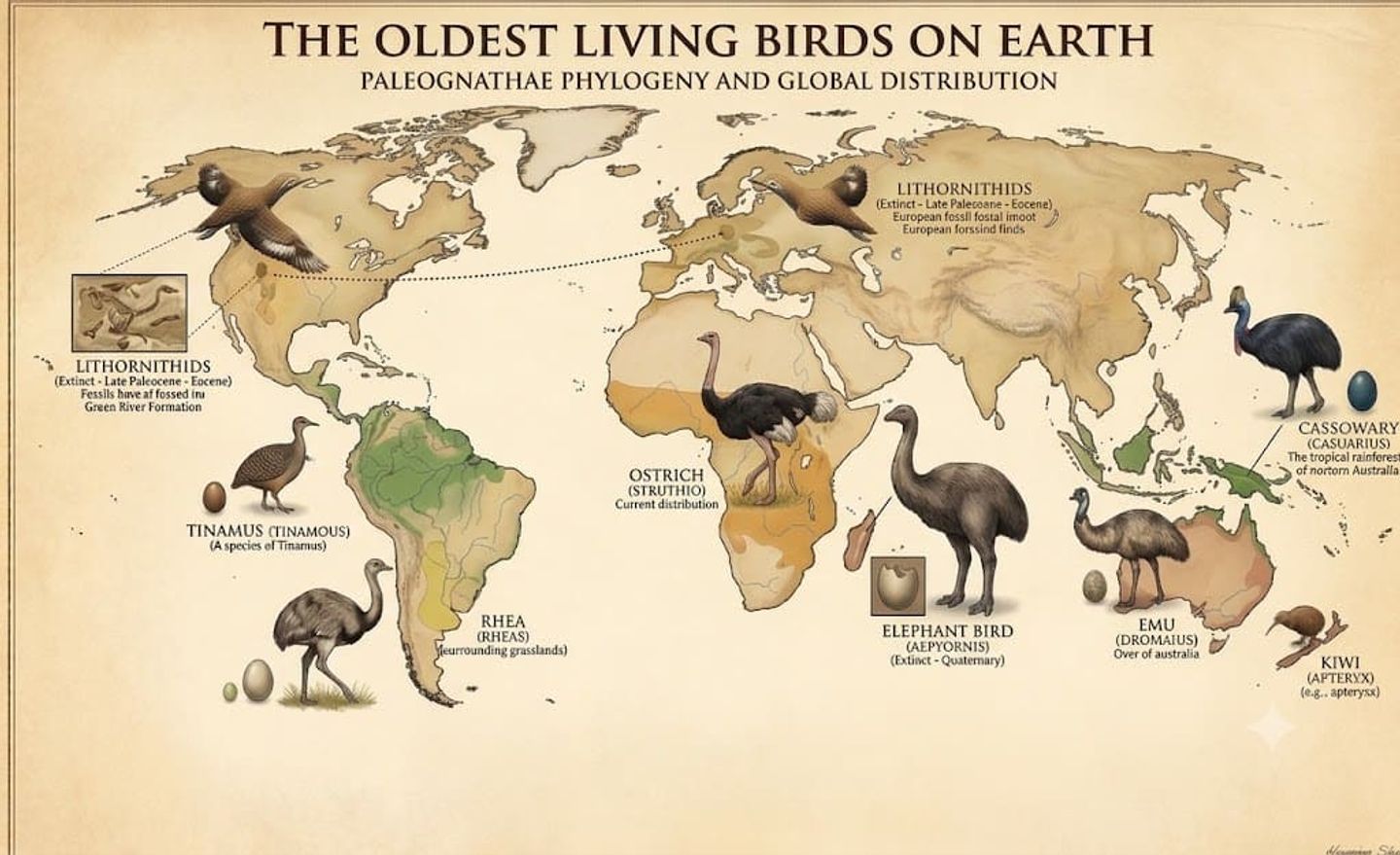
I learned that this group also includes the cassowaries and emus from Australia and New Guinea, the tinamous from Central and South America, the kiwis from New Zealand, and their extinct relatives, the moas from New Zealand and the giant elephant birds from Madagascar. There was even another extinct group called the lithornithiformes, which once lived in North America and Europe.
All of these birds belong to one of the oldest living bird lineages on Earth: the subclass Palaeognathae.
Today, this group contains about 59 living species (less than 0,5% of living birds). Tinamous are by far the most diverse, with 47 species, followed by five kiwi species, three cassowary species, two ostrich species, and one living emu species.
A story that began 66 million years ago
One of the most surprising discoveries was learning that all living palaeognaths share a common ancestor that lived around 66 million years ago.
This date is not random.
It marks one of the most dramatic events in Earth's history: the Cretaceous–Paleogene (K–Pg) mass extinction, the same event that brought the age of the non avian dinosaurs to an end.
Scientists believe this global catastrophe resulted from two major events occurring around the same time. The first was intense volcanic activity in the Deccan Traps of present day India. The second was the impact of a massive asteroid in what is now the Yucatán Peninsula in Mexico.
Together, these events dramatically changed Earth's climate. Dust, ash and aerosols filled the atmosphere, blocking sunlight for months or even years. As photosynthesis nearly stopped, food chains collapsed across the planet. Recent studies suggest that global temperatures dropped by around 10°C, creating harsh environmental conditions that pushed ecosystems to their limits. In the end, approximately 75% of all species disappeared.
What surprised me the most was learning that this extinction was not a disaster that ended in a few days, as movies often suggest. Although the asteroid impact itself happened in an instant, the environmental crisis continued for at least 300,000 years before ecosystems began to recover. Life on Earth did not simply return to normal. Surviving species had to endure hundreds of thousands of years of dramatic environmental change.
Yet, a small group of birds managed to survive.
These survivors looked nothing like today's ostriches, emus or rheas. They were probably small flying birds, perhaps resembling modern tinamous more than any other living palaeognath. Their small body size meant they required much less food than the giant dinosaurs. Their ability to fly allowed them to move across the landscape in search of scattered resources and escape deteriorating environments. Scientists also suggest that having a generalist diet, including seeds, insects and other foods that remained available after the collapse of forests, may have greatly increased their chances of survival.
Against all odds, these resilient birds survived one of the darkest chapters in Earth's history.
Those survivors eventually gave rise to all modern birds, known scientifically as Neornithes. Among them was the ancient lineage we now call Palaeognathae, which would later diversify into ostriches, rheas, emus, cassowaries, kiwis and tinamous.
It is fascinating to think that the ancestors of today's largest flightless birds were once small flying birds that endured one of the darkest chapters in Earth's history. They survived not because they were the biggest or the strongest, but because they were adaptable. Millions of years later, their descendants still walk our planet as ostriches, rheas, emus, cassowaries, kiwis and tinamous, living reminders of one of evolution's greatest survival stories.
The biggest surprise
At this point, I still believed that the distribution of these birds could be explained simply by the breakup of Gondwana.
The genetic evidence, however, tells a different story.
Modern phylogenetic studies show that rheas are actually more closely related to tinamous than to ostriches.
Even more surprising, tinamous can still fly.
This means that the loss of flight probably did not happen only once.
Instead, scientists now believe that the common ancestors of palaeognaths were capable of flight. As different populations spread across the world, several lineages independently lost the ability to fly while adapting to life on the ground.
In open environments, such as the African savannas where ostriches live or the South American grasslands and steppes where rheas are found, flying may have become less important. With very few trees available for shelter, moving quickly across long distances on the ground became a more effective strategy for finding food and escaping predators.
Over millions of years, natural selection favored birds with longer and stronger legs, better adapted for running than for flying.
Although ostriches and rheas evolved on different continents, they experienced similar environmental pressures.
This process is called convergent evolution.
Nature often finds similar solutions to similar problems.
That is why an African ostrich and a South American rhea look so much alike, even though they are not each other's closest relatives.
Another discovery that amazed me was learning that kiwis, the small nocturnal birds from New Zealand, are the closest living relatives of the extinct elephant birds of Madagascar, giant birds that could reach more than three meters in height.
A new way of understanding evolution
By the end of this investigation, I realized that the distribution of palaeognaths cannot be explained only by continental drift.
The evidence suggests that their ancestors could fly. They dispersed across different parts of the world, and once isolated, several lineages independently evolved into large flightless birds.
This story completely changed the way I think about evolution.
Now I see animals not as isolated species, but as the result of millions of years of Earth's history, shaped by climate change, mass extinctions, geographic barriers, continental drift and natural selection.
I also realized that geology, plate tectonics and evolutionary biology are not separate sciences.
They are different chapters of the same story.
To understand why a rhea lives in South America, an ostrich in Africa or a kiwi in New Zealand, we need to travel back tens of millions of years and imagine a planet that looked completely different from the one we know today.
Why science is so fascinating
I believe science is the most reliable way we have to understand our world.
At the same time, one of the things I admire most about science is that it never claims to know everything.
New evidence can change our understanding.
Perhaps one day scientists will discover a new fossil or obtain new genomic evidence that changes part of what we currently believe about palaeognaths.
And that is exactly how science should work.
Every discovery brings new questions.
What seems certain today may become even more interesting tomorrow.
What we do know is that the history of life on Earth is astonishing, incredibly long and wonderfully diverse.
Looking forward to Patagonia
If you made it this far, congratulations.
You probably share something with me: a deep curiosity about nature and a love for learning.
This November, my family and I will finally travel to Patagonia.
After everything I learned while writing this article, seeing a wild rhea will have a completely different meaning.
I will not simply be looking at a large bird.
I will be looking at one of the last living representatives of a lineage that survived the extinction of the dinosaurs more than 66 million years ago.
Of course, rheas are not my only target.
I also hope to visit some of Patagonia's incredible geological landscapes, including Torres del Paine, where mountains, glaciers and rocks tell another story written over millions of years.
Recently, someone also told me about a fossil site where fossilized jellyfish can still be seen preserved in the rocks.
How incredible is that?
Nature never stops surprising us.
I hope to share all of these experiences with you soon here on GeoNature.